
My war experience of being detained in Manchuria
(Last Update: )

Mr. S, who was drafted into the army during the last war and was detained in Manchuria for 8 years as a prisoner of war. What does it mean to be invaded by a totalitarian state and have one's freedom taken away? We asked Mr. S about his war experiences.
(S.K., Tochigi Prefecture, 90s, Male)
Monthly 'The Evangelism' No. 228 Reprinted and edited
 What is true peace?
To protect my precious family and Japan
In March 1922, I was born in Fengtian, Manchuria.
I was part of a family of eight, including my father, who was a communication technician dispatched from the Nagoya Central Broadcasting Station to Manchuria, my mother, two sisters, two brothers, and one younger brother. Due to my father's work, we returned to Japan when I was two years old, and the family lived in Nagoya.
From a young age, my parents taught me that 'fighting for Japan is to protect the happiness of our family and descendants,' and before long, I began to think that I wanted to serve my country as a soldier. I felt it was only natural for a man to do so.
Then, in 1944, just after graduating from a teacher training school for youth, I underwent conscription and joined the Imperial Japanese Army at the age of 21.
(The situation in Japan seems to be getting increasingly severe. I want to strike back for my country...)
Two years before I enlisted, in 1942, Japan had been facing a dire situation since its devastating defeat at the Battle of Midway.
I crossed over to Manchuria and underwent harsh initial soldier training.
However, one morning, I was suddenly struck by unbearable abdominal pain and had to be hospitalized in an army hospital. After being examined by a military doctor, I was diagnosed with appendicitis. I underwent surgery, but I couldn't be discharged for a long time, and every day was filled with anxiety. One day, while I was in the hospital, shocking news came in.
While I was hospitalized, my unit received deployment orders and suffered catastrophic damage off the coast of Taiwan. It was said that there were hardly any survivors.
(Is it right for me to be hospitalized? I am the only one who survived...)
I recalled the faces of my comrades who had trained with me. With a feeling of helplessness, I tightly gripped the sheets of my bed.
The end of the war. And to the prisoner of war camp.
Having lost the unit I was supposed to return to, I was assigned to the Fourth Army Headquarters in Harbin, where I was ordered to prepare battle reports and was engaged in that task.
Then, on August 15, 1945.
I received a message saying, 'There will be an important broadcast at noon, so gather in front of the radio.' When the time came, everyone in the headquarters listened intently to the radio.
"Enduring the unbearable and bearing the unbearable, we desire to open peace for all eternity—"
It was the imperial rescript announcing the end of the war.
(Did Japan lose?)
Some faces were frozen in shock, while others were shedding tears.
Everyone present felt regret.
For me, this day became a turning point in my fate. Just days before the end of the war, I was captured by the Soviet army, which had invaded Manchuria, breaking the Japan-Soviet Neutrality Pact, and became a prisoner of war.
After being disarmed, I was ordered to gather in Mudanjiang, Manchuria, and was placed in a large prisoner of war camp that housed over 1,000 people at all times.
Even though it was called a camp, it was just an open field. Everyone was forced to live in tents and straw bedding that they had brought with them. Armed Soviet soldiers and soldiers from the Chinese Communist Party, supported by the Soviets, were watching over us, so we could not resist, and we prisoners were utterly powerless.
As the highest-ranking prisoner, I, a sergeant, was ordered by the Soviet army to manage the prisoners, including food distribution. The meals there were akin to animal feed, consisting of millet and sorghum. Naturally, there were no dishes, so we walked around with food in the soldiers' hats instead of plates.
The sanitary conditions were poor, and an outbreak of typhus, transmitted by lice, occurred, leading to many deaths from weakness. On some days, as many as 200 people lost their lives.
(I want to go back to Japan. I want to see my mother...)
On a night in a foreign land, under the starry sky, I gathered with my fellow prisoners and sang Japanese songs.
The light of the fireflies, the snow on the window, the days of reading letters, piling up—
We encouraged each other, saying, 'We will be able to go home soon. Just a little longer. Let's hang in there, let's hang in there.'
Comrades who disappeared into Siberia
Then one day, a Soviet soldier instructed us, 'Prepare to group the prisoners into groups of 1,000 and put them on the train to return home.'
"It seems we can finally go back to Japan! That's great,"
I said as I organized the group. However, months later, I learned that the comrades who had left the camp with smiles saying, 'We can go back to Japan' had arrived not in Japan, where their family awaited them, but in the freezing land of Siberia.
I heard that many of my comrades, who were forced into harsh labor by the Soviet army in Siberia, lost their lives without ever stepping on their homeland's soil again.
(Did I deceive everyone by saying, 'You can go back to Japan'—)
Even though I didn't know the truth myself, regret welled up. However, there was nothing I could do about it now.
And about a year had passed since the camp life began. One day during the day, the voice of a soldier from the Chinese Communist Party echoed through the camp.
"Where is S? Come out!"
"Yes... it's me."
When I stepped forward, I was immediately captured by several soldiers. I was taken away as a 'reactionary element' to a prison.
Perhaps I was a nuisance to those managing the camp. Without any interrogation or questioning, I was suddenly thrown into a cell.
(What have I done...)
In the prison, there were many former Japanese soldiers like me, but among them were also Chinese who were fluent in Japanese and suspected of being spies for the Soviets or the Chinese Communist Party.
I couldn't tell where the spies were hiding, and there was no one I could confide in.
As I was confined in a closed environment for nearly a year, I began to be haunted by negative delusions.
(I will be killed here. I am going to die.)
I couldn't even imagine returning home, let alone having a future.
"Mom, K has come back,"
Just when I thought this was my place of death, one day I was suddenly thrown out of the cell.
With nowhere to go, I decided to rely on the Japanese refugee camp in Mudanjiang for the time being. Thanks to the kindness of the Japanese Refugee Association, I was able to find work at the Red Cross Hospital's boiler room and a place to stay, and I managed to find a way to survive.
I lived like that for a while, but there was still no prospect of returning home. On the advice of those around me, I decided to marry a woman from the same Japanese refugee community and establish a foundation for my life.
Then came 1953. Finally, I received news of the repatriation of Japanese people.
Eight years had passed since the end of the war. The long-awaited return home—.
"Mom, K is going back to Japan!"
I was so happy that I shouted loudly towards the sky, not caring about who was watching. I felt as if my voice would reach my mother back in my hometown.
On September 6 of the same year, I boarded the repatriation ship 'Takasago Maru.' As the cramped ship rocked for hours, Japan finally came into view.
When I went out on deck and looked at Maizuru Port, there was a crowd of people eagerly waiting for their families to return. Among them, I spotted my mother, whom I had seen in my dreams many times.
"Mom! It's K!"
"K! You came back well..."
It was a reunion after about nine years since I was deployed. Seeing my mother, who was holding a handkerchief to her eyes, I finally realized that I had come back alive.
Where do people go when they die?
After returning to Japan, I soon became a social studies teacher at a junior high school in Hokkaido. I got used to my job, and peaceful days continued, but I often remembered my comrades who lost their lives in the war and began to ponder, " Where do people go when they die? " and became interested in spiritual matters.
I read many religious texts in search of answers. However, I could hardly find teachings that clearly answered my questions.
Then, in 1989, after I had already retired from teaching, I encountered the book 'The Law of the Sun' by President Okawa, thanks to a friend's recommendation.
"When a person dies and returns to the afterlife, the memories of their life are not lost at all—"
(Huh, what does that mean...)
In 'The Law of the Sun,' it was taught that the essence of a human being is not the body but the soul, and that while being reborn in this world and the next, we are polishing our souls, as well as the nature of the spirit world and the truth of the beginning of the universe.
(This is what I wanted to know—)
From then on, I eagerly read President Okawa's books such as 'The Rebirth of Buddha,' 'The Eternal Law,' and 'The Golden Law.' In 1990, I became a member of Happy Science (Note 1) and began to study the truth of the Buddha's teachings.
In 2007, after my wife passed away, I made a firm decision to seriously reflect on my heart and entered the Senior Golden Hall (Note 2), the place for late-life training in Happy Science, about two years ago.
In the Senior Golden Hall, companions who study the teachings gather, and we practice reflection, meditation, prayer, study of scriptures and teachings, and physical fitness every day.
Thanks to the many Dharma friends (companions who study the teachings together), I never feel lonely. I feel grateful every day that I can spend a very enjoyable and happy late life.
(In the remaining years of my life, I will learn the teachings of Happy Science and do a 'final summary of my heart'—)
Note 1 For details on how to become a member of Happy Science, click here.
Note 2 Senior Golden Hall This is a religious facility prepared for members and believers aged 60 and over to engage in religious training under the "Late Life Ordination System." If you are interested, please feel free to contact the Senior Business Office. TEL 03-6384-0112

The book "Buddha's Rebirth" that I read multiple times with sticky notes.

The Senior Golden Hall of Happy Science (Utsunomiya City, Tochigi Prefecture)
Reclaiming pride in my life and my homeland

While working on "Lifetime Reflection" at the Senior Golden Hall, I often found myself troubled by thoughts of that war.
I have felt discomfort with the post-war trend that categorically labels the last war as "Japan's aggressive war" and states that "Japan harmed the people of China and the Korean Peninsula," while at the same time, as a former soldier, I have continued to feel a deep sense of regret.
However, there was an event that released such suffering.
President Okawa conducted spiritual messages for military figures such as Prime Minister Hideki Tojo and Lieutenant General Mitsuru Ushijima with his spiritual power, and he listened to their true feelings.
Through these spiritual messages, he clarified the truth that "the military personnel before the war were honorable individuals" and "Japan is not an aggressive nation," and he began a social enlightenment to revise the historical understanding of the last war.
As President Okawa said, that war was not started by Japan for its own interests, but was a "holy war" to liberate our Asian brethren who were oppressed by the Western powers. Including myself, the soldiers of that time shared this common understanding and, driven by a sense of mission, went to the battlefield without sparing their lives.
Although we were defeated in battle, many countries were able to gain independence after World War II thanks to Japan, being liberated from Western colonial rule.
I was able to regain pride in "my life" and "the country of Japan" because it became clear that the battle I fought with my life was not a "mistake." It was truly a feeling of being saved in my heart.
※3 Spiritual messages from military figures such as Prime Minister Hideki Tojo and Lieutenant General Mitsuru Ushijima: ' Public Spiritual Messages: Hideki Tojo Speaks on the 'Truth of the Greater East Asia War' ' Spiritual Messages from the Commander of the Okinawa Battle, Lieutenant General Mitsuru Ushijima ' published by Happy Science.
The truth about the comfort women issue
The former comfort women from Korea testified that they were forcibly taken to Mudanjiang in Manchuria where I lived. However, the truth is different.
The comfort stations were not operated by the military, but were run as a business by Korean entrepreneurs, and the women working there were so-called "professionals."
I have seen and heard this on the ground. Therefore, forced abduction is completely impossible. The discipline of the Japanese military was very strict, and superiors clearly warned that "one should not go to comfort stations." As a living witness, I want to correct the mistaken historical understanding after the war.
Now, totalitarian states like China and North Korea are trying to threaten Japan's peace. If Japan is invaded by such countries, we will lose our human rights and freedom, and we will have to endure extremely painful days...
Because I have experienced being a prisoner of war and being imprisoned by the Soviet Union and the Chinese Communist Party, I can speak with a sense of urgency about the crisis facing Japan.
Due to post-war education, having military power has come to be seen as entirely "evil," but national defense is a natural thing. It is about protecting important people and maintaining peace. Through this experience, I want to convey this to the young people who will carry the future.
To protect freedom and peace
From 'The Power of Religion to Protect the Country' (Written by Ryuho Okawa / Published by Happy Science)
The faith that underlies freedom
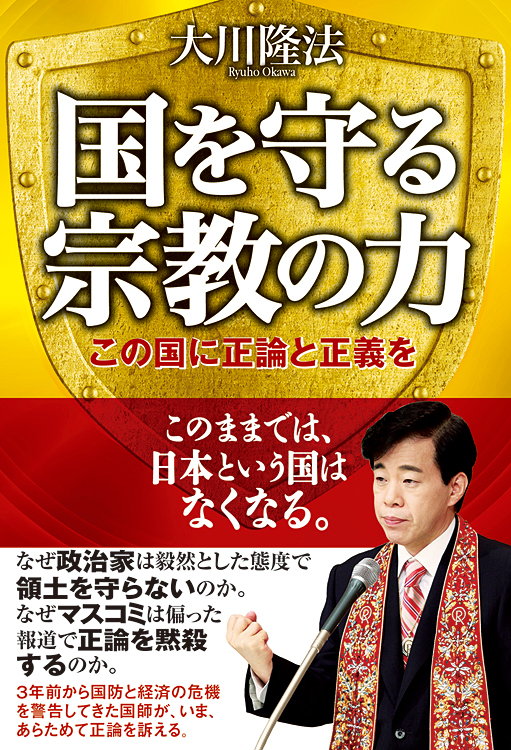
I have always preached, "Create a great nation of freedom," but freedom is truly an important value.
If one seeks only equality without freedom, there is a risk that freedom can easily be crushed by powerful and strong state power, so "securing freedom" is important.
And the foundation of freedom is faith.
Without freedom of religion, we cannot protect freedom of speech or freedom of publication.
Freedom of religion is the most important aspect that corresponds to the part where gods and buddhas are trying to protect "human dignity."
 Let's use the power of the heart
Would you like to learn the power of the heart and reverse your destiny?
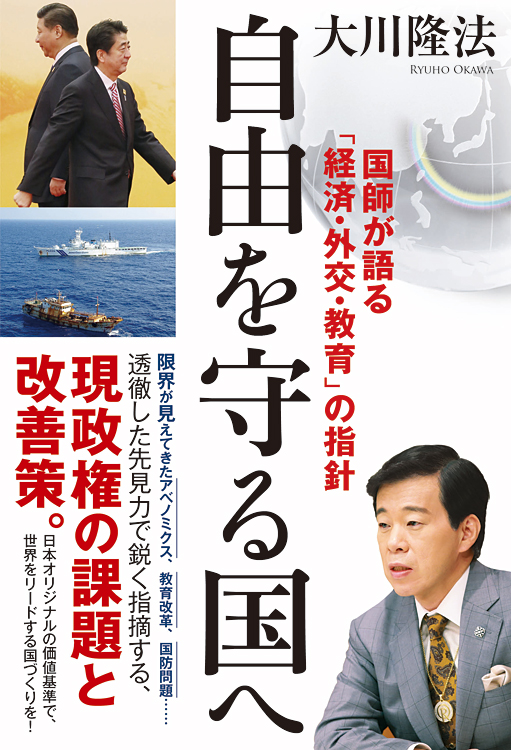
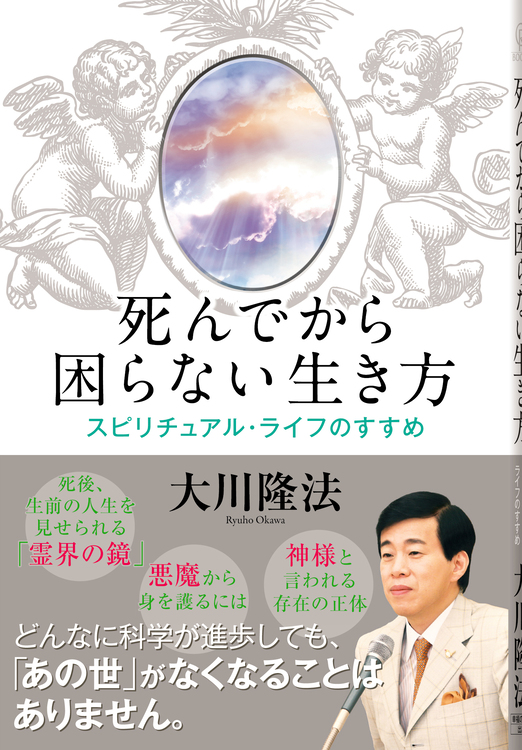
Read a book
 Listen directly to a Dharma talk
Reflect on your heart (Dharma training)
Currently being disclosed at nearby Happy Science temples and branches.
 Listen to the radio
Since its broadcast began in 1991, the radio program 'Angel's Morning Call' has continued to be loved by many listeners.
Ryuho Okawa IN Tokyo Dome 'The Choice of Humanity' Special (Part 1)
Please feel free to consult at your nearby branch.
You too can start a happy story.


PICK UP
 ログインが必要 … 閲覧には
 入会者限定 … 幸福の科学の会員のみ閲覧が可能です。
 三帰誓願者限定 … 幸福の科学の三帰誓願者のみ閲覧が可能です。
  植福の会参加者向け …
  大黒天信者向け