
The challenge of a gyoza shop that started from being broke at the 'bottom'
(Last Update: )

Mr. K, who runs a gyoza manufacturing company, actually took on his father's debt of about 30 million yen when he was 30 years old.
Mr. K has practiced the teachings of Happy Science and has carved out his destiny. This time, we will introduce the experiences of a manager who started a business from the 'bottom' of life and has continued to develop.
Mr. K.A (46 years old, Aichi Prefecture, company manager)
Bi-monthly 'The Evangelism' No. 230 Reprinted and edited
 The law of the mind that attracts abundance
The boyhood chasing after my father's back
In 1972, I was born as the third son to parents who ran a pig farming and agriculture business. My father was a businessman who not only inherited agriculture from my grandfather but also started pig farming in earnest and grew it significantly in one generation. My father was my idol, and I eventually began to think, 'I want to be like my father in the future.'
When I was 15, my eldest brother, who is seven years older, bought a book by President Okawa at a bookstore, which led me to encounter Happy Science.
I was fascinated by the large-scale teachings that I could not learn elsewhere, from the laws of the mind for success in life to the truth of the universe's creation, and I became engrossed in reading the books. At the age of 19, I became a member of Happy Science with my brothers because I wanted to learn more about the truth.

Mr. K around the age of 22. At the Toyohashi branch of Happy Science
"If this continues, our family will collapse together"
After graduating from my local high school, I got a job at a nationwide chain of general goods stores. At the age of 28, I was preparing to become independent in wholesale goods with the dream of 'wanting to start my own company.' One day, my father revealed a shocking story to me.
"A... Actually, our Chinese restaurant's management is in danger. Can you help out at the store?"
A few years ago, my father had closed the pig farming business and started a Chinese restaurant with my second brother. However, the management was tougher than expected, and they had incurred debts.
(Was it such a difficult situation...?)
My father had never asked me for help before. Realizing how tough the management must be, I decided to give up my dream for a while and help the family business.
Once I started working, the truly harsh situation gradually became clear. However, I couldn't just sit back and watch the debts grow.
(I think the taste of the food is good...)
While searching for what I could do, I came up with the idea of wholesaling my father's pride, handmade gyoza. After visiting retail stores multiple times to promote, I was fortunate to find a few places that placed orders. Still, the store's management could not recover easily.
(If this continues, our family will collapse... I have to do something)
In 2003, wanting to find a breakthrough, I decided to use my savings to participate in the 'Management Winning Strategy' training at the Chubu Seishinkan of Happy Science.
Many business owners gathered for the training. I, who had not started any business yet, participated among them.
The training explained the importance of vividly envisioning a great success.
(I have drawn the dream of 'wanting to start a business' many times. But somewhere in my heart, I felt like 'it's impossible for me'...)
Looking back, I lacked confidence compared to my admired father, feeling inferior in everything. However, at this critical moment, I switched my mindset to 'believe in myself and just try it.' I decided to start a business in gyoza manufacturing and sales. It was when I was 30 years old.
Hope that I did not lose even in the 'bottom' of life
However, after I started my business, my father's restaurant decided to close down. The family home where we lived was about to be auctioned off, and the total debt amounted to 30 million yen.
(Both my father and mother are already elderly. It might be difficult to pay off the debts from now on...)
I decided to repay the debts on behalf of my parents. I could not abandon the parents who had raised me.
I decided to use the warehouse of my family home, which had been used as a pigsty long ago, as the gyoza factory. However, since I was broke, it was a handmade factory that I remodeled myself by buying equipment from a home center.
At that time, my newly married wife also worked hard alongside me. The crucial gyoza manufacturing machine was passed down from my father's Chinese restaurant.
One day, while spending time at home with my father, he said,
"A, I have no assets or anything left. The only thing I can leave you is that gyoza manufacturing machine."
"Dad..."
Seeing my father muttering weakly, I vowed in my heart to make the business a success.
I immediately started working, and my wife and I made gyoza and went door to door selling them.
"Excuse me! How about some gyoza?"
"Thank you. The other day, I had your gyoza, and it was really delicious. Should I buy some today too?"
When I went peddling, there were many customers who happily bought our gyoza. Originally, I wanted to start a company dealing with general goods, and I thought until then that 'I started the gyoza business reluctantly.'
However, seeing the smiles of the customers, I felt pride in my work of making gyoza, and above all, passion began to well up within me.
On the other hand, our family's living situation was truly a 'day-to-day' existence. When money was tight, we sold anything that seemed sellable, like home appliances, books, and clothes, to get by. However, even in such circumstances, neither my wife nor I became the least bit resentful.
Having learned in Happy Science that 'the future envisioned in the heart becomes reality,' we continued to believe in a bright future where the company would develop instead of being pessimistic about the current situation.
Rather, I was happy to be able to create my own work by coming up with ideas on 'how to make customers happy,' thinking about products, and doing sales, working tirelessly without even taking a break.

A photo taken in front of the Chinese restaurant run by my father, with family and employees. (Mr. K is in the back row, far right)

Happy Science Chubu Seishinkan
Challenging to make additive-free gyoza using domestic ingredients
By 2007, nearly five years after starting the company, the business was on track, and my parents had started helping with gyoza deliveries.
One day, an elderly man called the factory with an inquiry.
"Can you make gyoza using domestic additive-free ingredients at your factory?"
The man said he wanted to sell 'gyoza with a focus on ingredients' at his retail store and was looking for a new product.
However, he said he was having trouble finding good products. He heard about our company and contacted us.
(We have no knowledge of processing additive-free foods or sourcing domestic ingredients. But...)
For a moment, I hesitated whether to take on the job. However, the words of President Okawa's 'Winning Mindset' suddenly came to my mind.
"You need to constantly think about how to open up paths. It's not about arbitrarily deciding on a bottleneck based on the current situation,
but always considering, 'How can we open up a path?' and 'Is there any ingenuity we can apply?'"
(That's right. There must be a way. Let's explore the methods.)
I absolutely cannot disregard the customers who have relied on our company. I decided to take on the challenge of an unfamiliar job.
From then on, it was a continuous trial and error every day. First, I gathered information on domestic ingredients such as meat and vegetables. Seeking satisfactory ingredients, I personally visited farmers and brought various combinations back to the factory to try.
I also conducted research to extract umami without using seasonings containing additives. I wanted to meet the expectations of my customers—this single-mindedness led me to immerse myself in product development.
And finally, the gyoza was completed. I delivered the product to the customer who ordered it and had them taste it right away. The customer put the gyoza in their mouth and set down their chopsticks. I felt the sweat on my hands as I waited for their comment.
"K-kun, it's delicious. This is good. Thank you for working so hard."
(I'm glad...!)
I felt relieved that I could provide a product that made the customer happy. Furthermore, the customer saw my attitude towards work and trusted me, leading to further orders. Not only that, but they also introduced me to other retail partners and farmers. Since then, orders for the next job started coming in as a result of those introductions.
(Trust is indeed an asset—)
Shortly after this, an incident occurred in a neighboring country where toxic substances were found in frozen gyoza, causing public interest in 'food safety' to surge. Our domestically produced additive-free gyoza, which had just been completed, quickly spread through word of mouth.

Two books that K-san has loved for many years. He opens them from time to time to gain hints for work.
"The mindset of the manager reflects in the management."
As sales increased, I began to hire employees, and it seemed that the company would continue to develop smoothly. However, suddenly, performance plummeted, leading to continuous deficits and a management crisis.
(Why aren't we selling...?)
I was in a panic, unable to understand the cause. Before I knew it, I was only thinking about sales, asking myself, 'How much are we selling now?' Eventually, I even began to doubt whether my important colleagues were working properly.
One day, a senior business acquaintance, noticing my troubled state, spoke to me.
"Don't get so worked up over that."
Those words brought me back to my senses. I had become trapped by the drop in sales and lost sight of the 'more important things.'
I prayed to the main deity of Happy Science, which I have enshrined at home, and reflected on each of my past mistakes.
(I hadn't grown as a leader...)
President Okawa teaches in 'Introduction to Management' that "the limitations of the top leader become the limitations of the company's development." I realized that I lacked the broad perspective and forward-looking management strategies necessary for a leader.
I found many points for improvement in management, such as 'selling what we wanted to sell,' but they all traced back to my own 'laxity of heart' as the top leader.
(Let's use this crisis as a springboard.)
I reevaluated my work. I observed customers and thought about 'what to provide to make them repeat customers,' and I made improvements, such as creating Chinese side dishes in addition to gyoza. As a result, I was able to rebuild the company in about three months.
I want to fulfill the mission of Daikokuten.
The period when management was precarious coincided with a time when I had neglected my spiritual practice of self-reflection due to daily busyness.
Realizing that it is essential for a manager to engage in self-reflection and deepen their education, I have since become more proactive in participating in training and prayers at Happy Science temples and branches than ever before.
One time, while meditating during training at the Chubu Seishinkan of Happy Science, I had a mysterious experience. I saw a vision of my guardian spirit joining me in selling gyoza.
(Invisible beings are always supporting me...)
We humans are beings sustained by deities and Buddhas. I thought that returning that grace to the world is the essence of work.
(I want to contribute even more to the development of Toyohashi and Japan!)
With this strong desire, I began to energetically develop and sell a variety of gyoza using local vegetables and meats in cooperation with livestock farmers. I didn't just use local ingredients; I challenged myself to maximize their appeal.
Now, I have also joined the community of local farmers, listening to their concerns and suggesting ways to help promote agricultural products, and my business is further expanding.
When I started the company, I was burdened with a large amount of debt and was barely surviving. Now, I have paid off my debts and have been able to grow the company. This is all thanks to the support of many people and, above all, the guidance of deities and Buddhas.
If I hadn't encountered Happy Science, both my family and I might have been wandering the streets by now. In the future, I want to continue developing with a global perspective and enrich people's lives through food. I want to do whatever I can to achieve that. I will fulfill that mission of Daikokuten.

Materials from the Professional Course for Truthful Managers at Happy Science Chubu Seishinkan that K-san attends monthly.

Our brand of flour 'Sakura' developed with inspiration gained from training at the temple.

K-san, who manufactures gyoza skins. He also helps with production in the factory during breaks from product development and his role as president.

With the members of the Happy Science Toyohashi branch that K-san frequently visits. Conversations with fellow believers are a moment of relaxation.
[Explanation] What are the points that K-san attracted abundance?
Point 1 Worked sincerely and gained the trust of customers.

President Okawa teaches that honesty and sincerity are the foundation of trust and the principles of business development. K-san faced even the most difficult jobs with a sincere desire to meet customer expectations. That attitude became the trust and reputation of the customers, leading to the company's growth.
Point 2 Works with the thought of 'for the happiness of people and society.'

K-san has continued to work not just for his company's profit, but with the feeling of 'to make customers happy' and 'to enrich all of Japan.' There is a principle that wealth gathers to those who work with a loving desire to serve others.
 Recommended BOOK that gives hope for life.
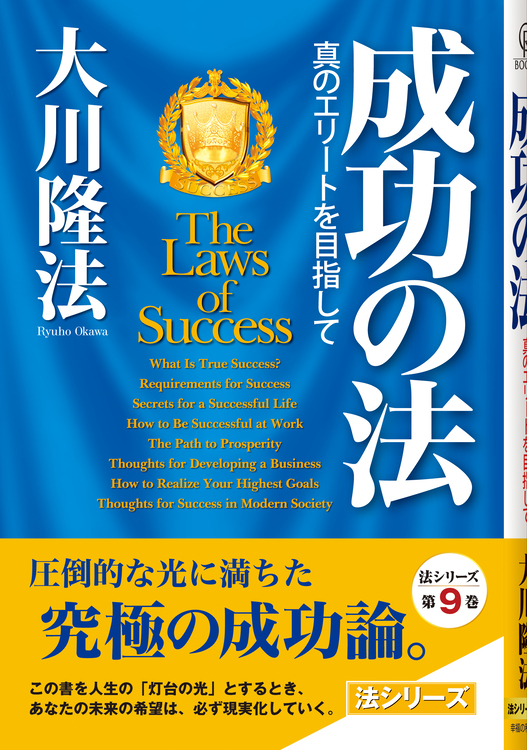
'The Law of Abundance' (by Ryuho Okawa / Happy Science Publishing)
Words to seize success in life.
There is no need to think, 'I want to make money.' Money will surely follow those who sincerely and diligently work for the benefit of others.

Have you found your 'problem set of life' and solved it?
 Let's use the power of the heart.
Would you like to learn the power of your heart and turn your destiny around?
Read a book

 Listen to a Dharma talk directly
The Success Studies of Luck (うん), Dullness (どん), and Roots (こん)
Currently being disclosed at nearby Happy Science temples and branches.
 Listen to the radio
Since the start of broadcasting in 1991, the radio program "Angel's Morning Call" has continued to be loved by many listeners.
Feel free to consult at your nearby branch.
You can also start your happy story.


You may also like


PICK UP
 ログインが必要 … 閲覧には
 入会者限定 … 幸福の科学の会員のみ閲覧が可能です。
 三帰誓願者限定 … 幸福の科学の三帰誓願者のみ閲覧が可能です。
  植福の会参加者向け …
  大黒天信者向け