
Do those who have attained Buddhahood (those who have returned to heaven) also need to be memorialized during Higan and Obon? 【True Stories from the Spiritual World】
(Last Update: )
Q. Do those who have attained Buddhahood (those who have returned to heaven) also need to be memorialized during Higan and Obon?
A. Remembering and expressing gratitude once or twice a year becomes a virtue for our ancestors in the afterlife.

Ways to express gratitude to ancestors in heaven
When we talk about ancestor memorial services, there is a significant distinction between those who have attained Buddhahood (those who have returned to heaven) and those who have fallen into hell.
In the case of returning to heaven, it means that they have successfully completed their training in this world and graduated. Death is, in a sense, a graduation ceremony from this world, and going to the afterlife is like an entrance ceremony.
In that sense, death is actually a joyous occasion, and the living should say to those who have returned to heaven, 'Congratulations on successfully completing your training.'
Furthermore, one should say, 'We, your descendants, take pride in you. We will continue to strive and make efforts following your example, so please guide us. Also, to repay your kindness and virtue, we would like to express our gratitude to you every year during the Obon and Higan seasons. Please accept this feeling.'

When remembered by those on earth, spirits in the afterlife are also pleased.
Since we have received various blessings from our ancestors, starting with having a physical body, it is important to express gratitude properly once or twice a year.
It is not necessary to do this every day, but remembering and expressing gratitude once or twice a year makes those ancestors who have returned to heaven happy.
Being thanked with 'Thank you' by descendants signifies that the ancestors had virtue. In the afterlife, friends around them might say, 'You are very cherished by your descendants. You must have had a lot of virtue in your lifetime,' which is also a source of joy for those in the afterlife. Additionally, when friends or acquaintances pass away, they are also pleased when the living remember them.
Conversely, not being memorialized by anyone means they have been abandoned by their relatives or descendants, or that they were disliked by many during their lifetime. The willingness of the living to memorialize them indicates that the person had some virtue.
In short, there is no need for the living to provide salvation to those who have returned to heaven, so we should pray for their success in the afterlife and also pray, 'Please guide us from time to time.'
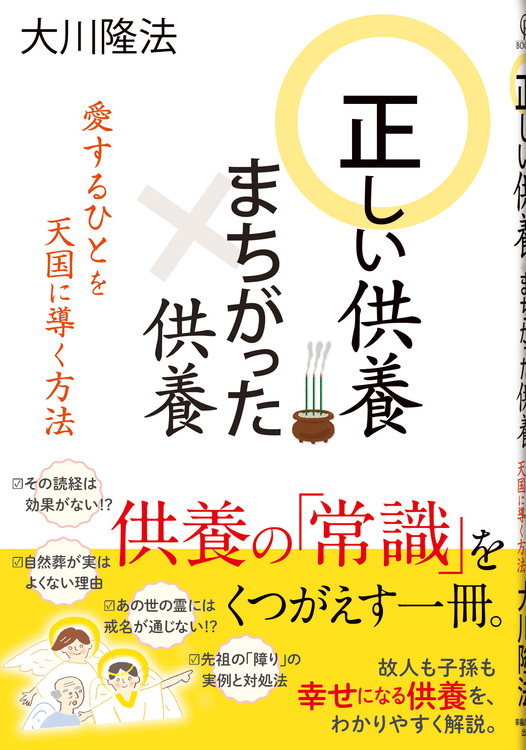
References:'Correct Memorial Services, Incorrect Memorial Services'

主エル・カンターレの救いの光―幸福の科学の「供養」
故人を偲び、来世の幸福を祈る供養の心は尊いものですが、その一方で、迷っている故人の霊を成仏へと導くには、正しい霊的知識を知らなければ難しいのも事実です。
主エル・カンターレ、大川隆法総裁は、「どのような心で生きた人が、天国に還るのか」「地獄から天国に上がるには、どうすればよいのか」など、私たちが、この世でもあの世でも正しく幸福に生きるための教えを、数多く説いてくださっています。
すべての人の幸福を願われる、主エル・カンターレの教えから、「正しい供養」のあり方を学んでみませんか?

Why are people born? Where do people go when they die?
Answering such fundamental questions is considered a significant mission of religion by Happy Science.
Knowing spiritual truths can greatly change one's life. This site conveys spiritual truths on various themes.
Related Articles


Related Books



You may also like


PICK UP

 ログインが必要 … 閲覧には
 入会者限定 … 幸福の科学の会員のみ閲覧が可能です。
 三帰誓願者限定 … 幸福の科学の三帰誓願者のみ閲覧が可能です。
  植福の会参加者向け …
  大黒天信者向け